Most venture documentation in India has settled into a shape. A term sheet, a share subscription agreement, a shareholders' agreement, a diligence list that runs to sixty items, and a set of investor protections that everyone on both sides recognises. For a consumer or software company, that shape works. The business is legible, the assets are contractual, and the main risks are commercial.
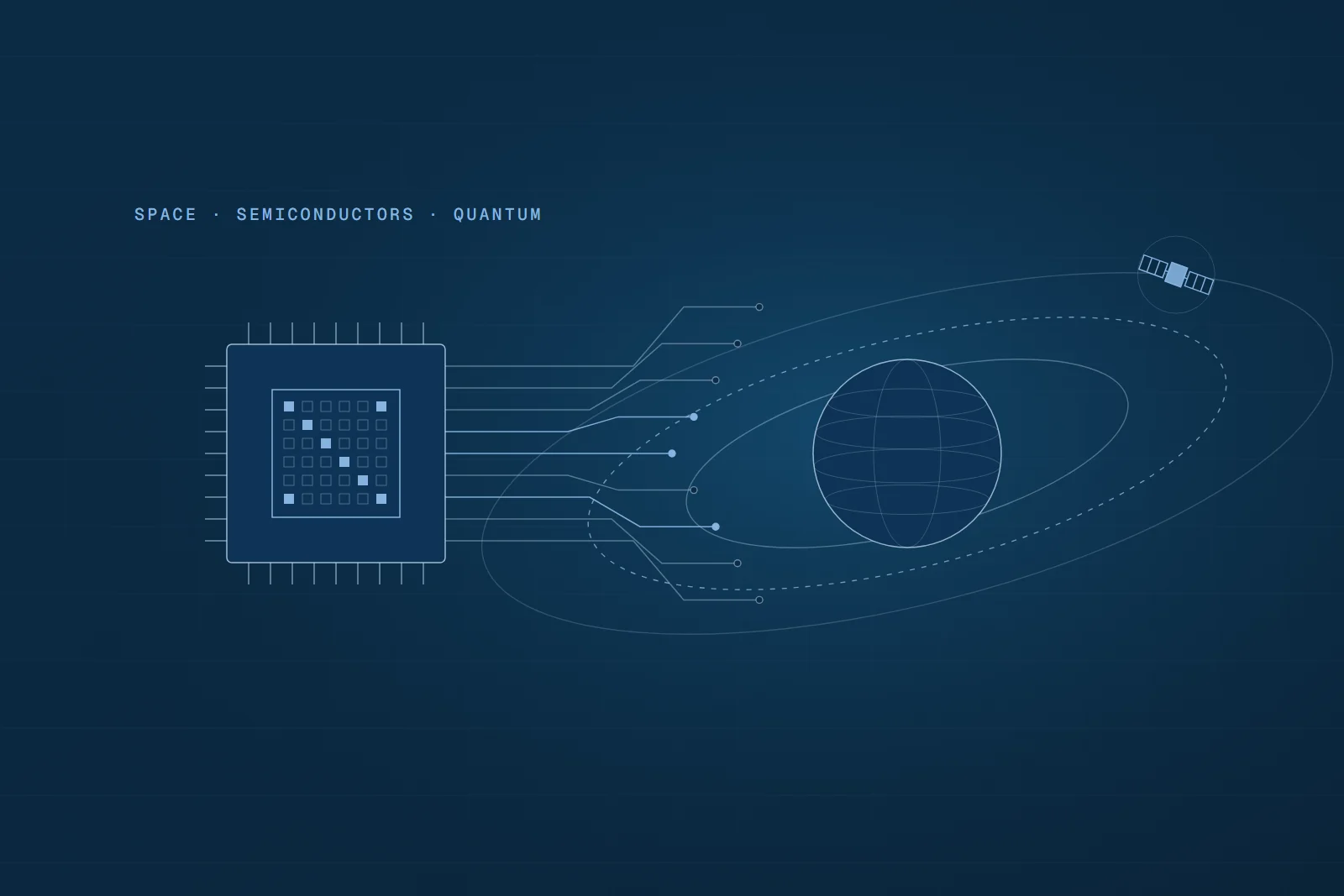
Deeptech does not fit the shape. Space, semiconductors, defence-adjacent systems and quantum computing carry problems that the standard template was not built to hold.
The friction is rarely bad faith. It is usually two reasonable positions that the documents have no clean way to reconcile.
Some of this is genuinely new. IN-SPACe (the Indian National Space Promotion and Authorisation Centre) was set up in 2020, the Indian Space Policy followed in 2023, and the FDI (foreign direct investment) rules for the sector were rewritten in 2024. The policy push extends beyond space: India has introduced a National Deep Tech Startup Policy, the Research, Development and Innovation Scheme, and expanded semiconductor incentives through the India Semiconductor Mission. Money has moved into these sectors faster than deal documents have caught up, so both sides are often using paper written for consumer internet deals to try to fit a very different kind of business.
The template does not usually show its cracks right away. It produces a covenant the company cannot meet, a condition precedent nobody controls, or a diligence answer nobody has actually checked, and the problem only shows up two years later, once it is expensive to fix.
Eight such failures are set out below, from both sides of the table. Most of them are capable of stalling a round that both sides want to do.
1. The regulator sits on the critical path
For a space company, authorisation from IN-SPACe is not a compliance formality that follows the raise. It is a precondition to operating at all. Spectrum comes from the WPC (Wireless Planning and Coordination Wing). Some activities need clearances that no amount of preparation can accelerate.
The founder cannot promise a date, because the date is not theirs to give. The investor wants a condition precedent with a longstop (a fixed backstop date by which the condition must be met), because an unauthorised business is not the business they agreed to fund.
Neither position is unreasonable, and the deal stalls anyway. What tends to resolve it is separating what the company controls from what it does not. A condition precedent that the company must have applied and answered the regulator's questions can actually be met. A condition precedent that authorisation must be granted is a hostage to a third party. Where the authorisation genuinely decides whether the business can operate, the honest structure is tranching against it (releasing the investment in stages tied to progress) rather than pretending a longstop date will fix the timing risk. Tranching brings a drafting problem of its own, which the eighth section takes up.
Tranching is not a complete answer, and the harder question it invites is what protects a tranche that has already been paid. If the authorisation never comes, there is very little the documents can do to recover it. An assured return or a fixed-price exit is not available to a non-resident investor under the FEMA rules, and a buy-back is capped by the Companies Act and needs free reserves an early-stage company does not have. What is left is structural rather than remedial: keep the first tranche small enough to be treated as the cost of finding out, hold subscription monies in escrow against the authorisation where both sides will wear the mechanics, and price the residual risk rather than draft around it.
2. The IP traces backwards
Founders in this sector usually come from somewhere. An ISRO (Indian Space Research Organisation) centre, an IIT (Indian Institute of Technology) lab, a CSIR (Council of Scientific and Industrial Research) institute, or a prior employer working on adjacent technology. The core insight often predates the company.
That raises a question standard diligence handles badly. A patent filing tells you who applied. It does not tell you whether the underlying work was done under a sponsored research agreement, whether the institution's IP (intellectual property) policy claims ownership, or whether an employment contract with a former employer captured it.
For the founder, this can feel like their honesty is being questioned. For the investor, it is the single largest asset on the balance sheet resting on an assumption.
The practical answer is to look for documents rather than comfort. Assignment deeds, institutional no-objection letters, the terms of any technology transfer, and the IP clause of the previous employment contract. Where those do not exist, a representation is not a substitute for the document, and it is more honest to price that risk into the deal than to hide it with wording.
3. Grant money is not clean money
BIRAC (the Biotechnology Industry Research Assistance Council), TDB (the Technology Development Board), iDEX (Innovation for Defence Excellence), the design-linked incentive schemes under the India Semiconductor Mission, and various state grants: deeptech companies collect these early because equity at that stage is expensive and grants are not.
The conditions attached are rarely read alongside the investment documents. Some require the company to remain Indian-domiciled. Some restrict transfer of the funded IP. Some require consent or notification on a change in control or shareholding. Some carry recovery rights if milestones are missed.
The collision is with ordinary investor rights. A drag-along that forces a sale, a right of first refusal that changes control, a flip to an offshore holding structure at Series B, all of these can breach a grant condition that nobody surfaced at seed.
Founders should treat grant agreements as part of the disclosure set from the first round. Investors should ask for them by name. They rarely appear on their own.
4. FDI is sector-specific here in a way it usually is not
For most sectors, foreign investment is a settled question and the diligence takes ten minutes. Space is not most sectors. Following the 2024 amendments, the treatment varies by sub-activity: satellite manufacturing and operation, ground and user segment, launch vehicles and spaceports, and component manufacturing each sit at different automatic-route thresholds (the investment level up to which no government approval is needed), with government approval required above them.
The consequence is that the same cap table can be fine for one activity and a problem for the one next to it. A company that adds a launch capability to a satellite business has changed its FDI position without changing a share.
Press Note 3 (the rule requiring government approval, rather than automatic clearance, for investment connected to a country sharing a land border with India) adds a second layer wherever there is a land-border-country connection, direct or beneficial. That is not a deeptech rule, and it applies across sectors, but it stacks on an approval regime that is already sub-activity specific, so a single round can need two clearances rather than one. Press Note 2 of 2026 has since narrowed its reach: an investor from a land-border country holding up to 10 per cent without control can now come through the automatic route, tested on a look-through basis and subject to reporting, with government approval still required above that threshold or wherever control changes hands. That question has to be asked about the fund's own limited partners, not only about the company, and asked early enough that the answer can still change the structure. In space and defence-adjacent work there is a second reason to ask it: the identity of the ultimate investors can surface again in licensing and in export-control end-use assessment, where no 10 per cent safe harbour applies.
For founders, this means a foreign cheque may cost more time than it appears to. For investors, it means the structuring question belongs at the term sheet stage, not at closing.
5. Export control is a live commercial constraint
Dual-use technology sits on the SCOMET (Special Chemicals, Organisms, Materials, Equipment and Technologies) list. Anything that touches propulsion, imaging, cryptography, certain materials or high-end computing may need a licence before it can be sold or shared across a border. In practice, that includes sharing technical data with a foreign shareholder or a foreign group entity. The control attaches to the transfer of the technology, not only to the sale of the product.
Founders often discover this when they are ready to ship. Investors often discover it when the company's addressable market turns out to require a licence per customer.
Two things follow. First, board observer rights and information rights for a foreign investor have to be drafted against what can lawfully be shared. A standard information covenant promising monthly management accounts, board packs and access to technical records is easy to sign and hard to perform, and it is the company that carries the consequence of performing it. The workable version separates commercial reporting, which can flow freely, from technical data, which flows only where a licence permits, with a mechanism for the investor to receive a redacted set rather than nothing at all.
Second, the revenue model has to be tested against which parts of it depend on licences the company does not yet hold. A pipeline built on export sales into four countries is four separate licensing assumptions, and they are not equally safe. Neither side should file this as a compliance footnote. It determines the size of the market being priced.
6. Value is concentrated in people, not filings
In a software company the product survives the founder leaving. In deeptech, a small number of people hold knowledge that is not written down anywhere, and often could not be.
The standard tools do not fit well. Post-employment non-competes are unenforceable in India. Founder lock-ins can be negotiated but do not compel anyone to keep thinking. Employee IP assignment is essential and is frequently missing from the contracts of the technical staff who matter most.
The non-compete point deserves more than a line, because investors used to other jurisdictions routinely assume the opposite. Section 27 of the Indian Contract Act voids agreements in restraint of trade, and there is no reasonableness test that can rescue a post-termination restraint, however short or narrowly drawn. The Delhi High Court restated the position in Varun Tyagi v. Daffodil Software in 2025. Restraints operating during employment are a different matter and are enforceable, which means the levers that actually exist are notice periods, garden leave (paying a departing employee to stay away during their notice period rather than work for a competitor) and the length of the employment relationship itself, rather than a promise about what someone will do after they leave.
There is one exception that matters in a financing. A non-compete given by a founder as a seller of goodwill, tied to a genuine transfer of the business, can fall within the statutory exception and be enforceable. A founder non-compete parachuted into a shareholders' agreement with no such transfer behind it is unlikely to be, whatever the drafting says. It is worth knowing which of the two is being negotiated.
What actually does the work is duller. Assignment clauses in every technical employment contract, from the beginning. Confidentiality obligations, which are enforceable and worth drafting with care. Non-solicit terms, which sit in a greyer area and work better as deterrence than as remedy. Vesting and ESOP (employee stock option plan) structures that make staying rational rather than making leaving punishable. And an honest recognition, on the investor side, that key-person risk in this sector is priced rather than eliminated.
For founders, this means retention is a hiring and equity question rather than a drafting one. For investors, it means the key-person clause in the shareholders' agreement is close to the least valuable protection in the file, and the assignment clauses in a dozen technical employment contracts are close to the most.
7. Government revenue is a different asset
A large part of the early pipeline for space and defence companies is government. iDEX contracts, ISRO work, public sector customers, defence procurement.
That revenue behaves unlike commercial revenue. Cycles are long, payment terms are what they are, and termination for convenience appears in places a commercial customer would never get away with. Much of the pipeline shown in a data room is memoranda of understanding rather than binding orders.
Investors misprice this in both directions. Some treat a memorandum of understanding as revenue. Some discount government contracts to nothing when a signed order with a public sector buyer is more secure than most commercial contracts of the same size.
The useful diligence question is not the size of the pipeline. It is which items are binding, what triggers payment, and what happens on cancellation.
8. Hardware timelines break the standard instrument
A compulsorily convertible preference share priced against software comparables assumes an exit horizon that a hardware company will not meet. First revenue may be four or five years out. The liquidation preference, the anti-dilution ratchet and the conversion mechanics were all designed on a shorter clock.
Milestone-linked tranching is the common response, and it is the right instinct. The execution is often poor. Milestones drafted as revenue targets do not suit a company whose next two years are qualification and testing. Milestones tied to regulatory grants reintroduce the problem in the first section. Milestones that require investor satisfaction in their sole discretion are not milestones at all, and are worth naming as such at the term sheet stage.
Milestones that work are objective, within the company's control, and technical rather than commercial. A completed qualification test. A demonstrated performance threshold. A delivered unit.
Tranching, though, answers a different question from the one the instrument poses. It fixes when the money goes in; it does nothing about a liquidation preference, a ratchet or a conversion deadline that assumes a five-year exit. Those need their own answers. A valuation reset at each tranche does most of the work an anti-dilution ratchet was there to do, and does it with less damage to the founders. The conversion mechanics have to be drafted against the real horizon from the outset, because for a non-resident subscriber the conversion price or formula is fixed at issue and cannot be renegotiated once the clock has run.
The common thread
Each of these is a case where the standard document assumes something that is not true in this sector. That the regulator is downstream of the deal. That the intellectual property begins with the company. That grants are free money. That the cap table question is settled. That value lives in assets rather than people. That revenue behaves commercially. That five years is a long time.
There is a pattern underneath the pattern. In each case the template treats something as a fact when it is really a variable, and treats that variable as though it sat within someone's control. The regulator's timetable, the provenance of an invention, the conditions attached to a grant, the composition of a fund's own investor base: none of these is the kind of thing a representation can fix, and drafting harder does not make any of them more certain. What the documents can do is allocate the risk explicitly, price it, or stage the money against it. What they cannot do is assume it away.
None of this makes deeptech harder to fund. It simply means it has to be documented differently. The rounds that close cleanly are usually the ones where both sides identified the failing assumption early and spent their negotiating capital on it, rather than on the twelve standard points that were never going to matter in this business.
The work is not to invent new documentation. It is to notice which assumption has failed and to draft for the version of the business that actually exists.
This note reflects the regulatory position as of September 2026 and is general commentary rather than advice on any particular transaction.
This article is for general information only. It is not legal advice and does not create a lawyer–client relationship. For advice on your situation, please contact us.